Words Are Like Children
Posted by Helena Smole in Other on Apr 17th, 2023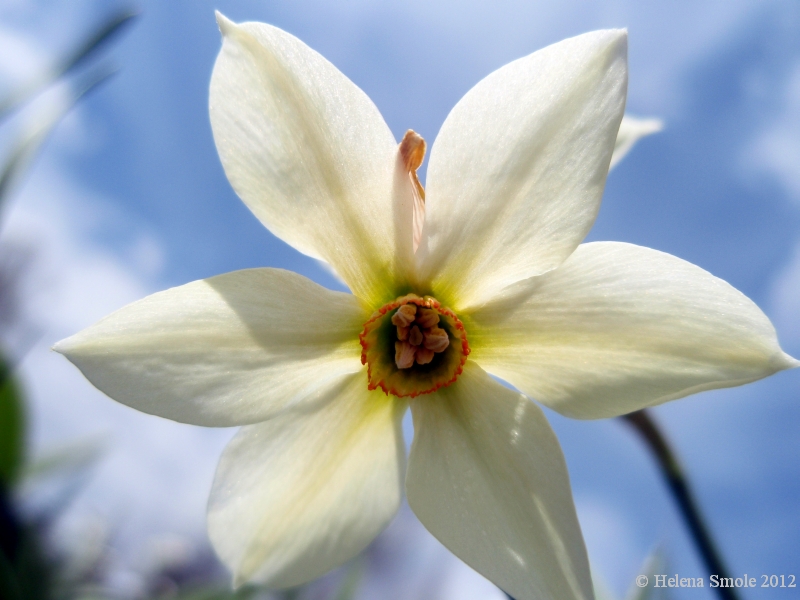
Daffodil (Narcissus poeticus).
Words are like children. You have to take care of them, but they also have a mind of their own.
Take loanwords for example. They have a life of their own once imported from a language to another language.
In Slovene we often try to find a Slovene new word to replace a loanword, but it does not always work. Sometimes we keep both the loanword and the Slovene replacement. They might even slightly differ in meaning over time. In other cases one of them prevails and the other once dies. Let us take a look at a few examples.
In Slovene we use both laptop and prenosnik. They mean the exact same thing: “portable personal computer”. It is true that laptop is more colloquial and you will read prenosnik in books and magazines. But who knows, with time, maybe the longer prenosnik will die out and we will use only the laptop. It is the same case with slide and drsnica in Power Point presentations. Or with komp and računalnik, one being a simplification of English computer and the other one being a translation of it. Slovene strežnik is also a direct translation of the English server. Slovene server is colloquial, while strežnik is used in formal texts. It makes you think, why after all these years, people still use the original English loanwords in informal speech.
And why is it then that in Slovene nobody says mouse for “computer mouse”? We say in informal speech and write and say in formal speech miška, which is a direct translation of the English word for the animal/computer part. Language is definitely mysterious.
God knows, if in a hundred years from now we will still have the upper synonyms. We used to have jazz and džez, but jazz won over the years. One sees džez written rarely. By the way džez is only the Slovene way of writing down the sound of jazz, it is obviously no translation.
In my opinion, language is a living organism. It has a mind of its own and it changes over time. One would think, by writing dictionaries and grammars, we would freeze the language and prevent it from changing. But we do not. Language does clearly not abide by the rules in linguistic works. Instead, it evolves and every couple of decades language scientists have to write new grammars and dictionaries.
Take care,
Helena Smole, author of:
– a fantasy novel with romance Vivvy and Izzy the Dwarf: A series about relationships
– Balancing the Beast, a book offering a bright view of schizoaffective disorder ˗ bipolar or manic-depressive type

Leave a Reply

Follow me


